
PROJECT MANAGER
2026
Watercolor on Paper
26 × 20 cm | 10 1/4 × 7 7/8 in
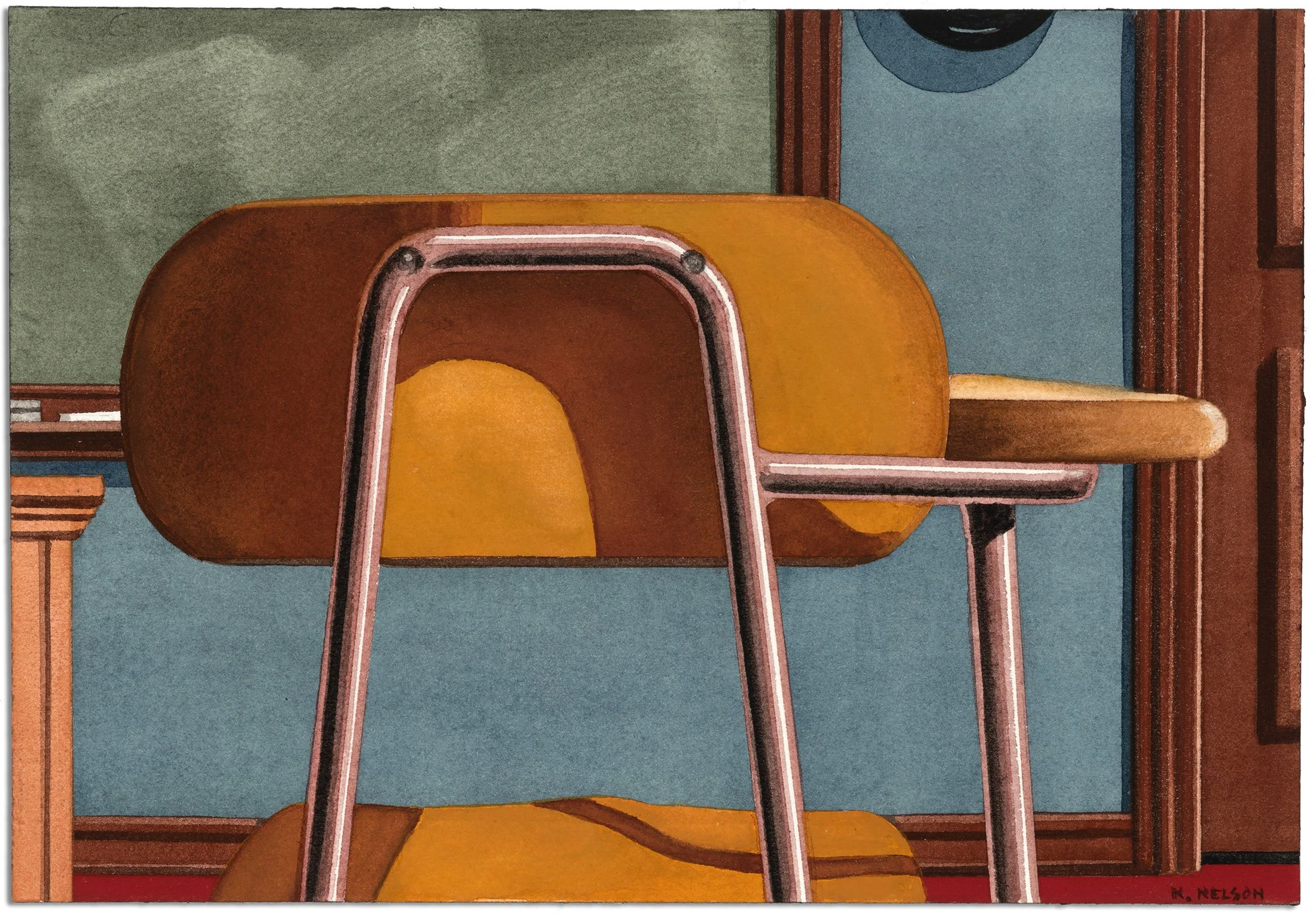
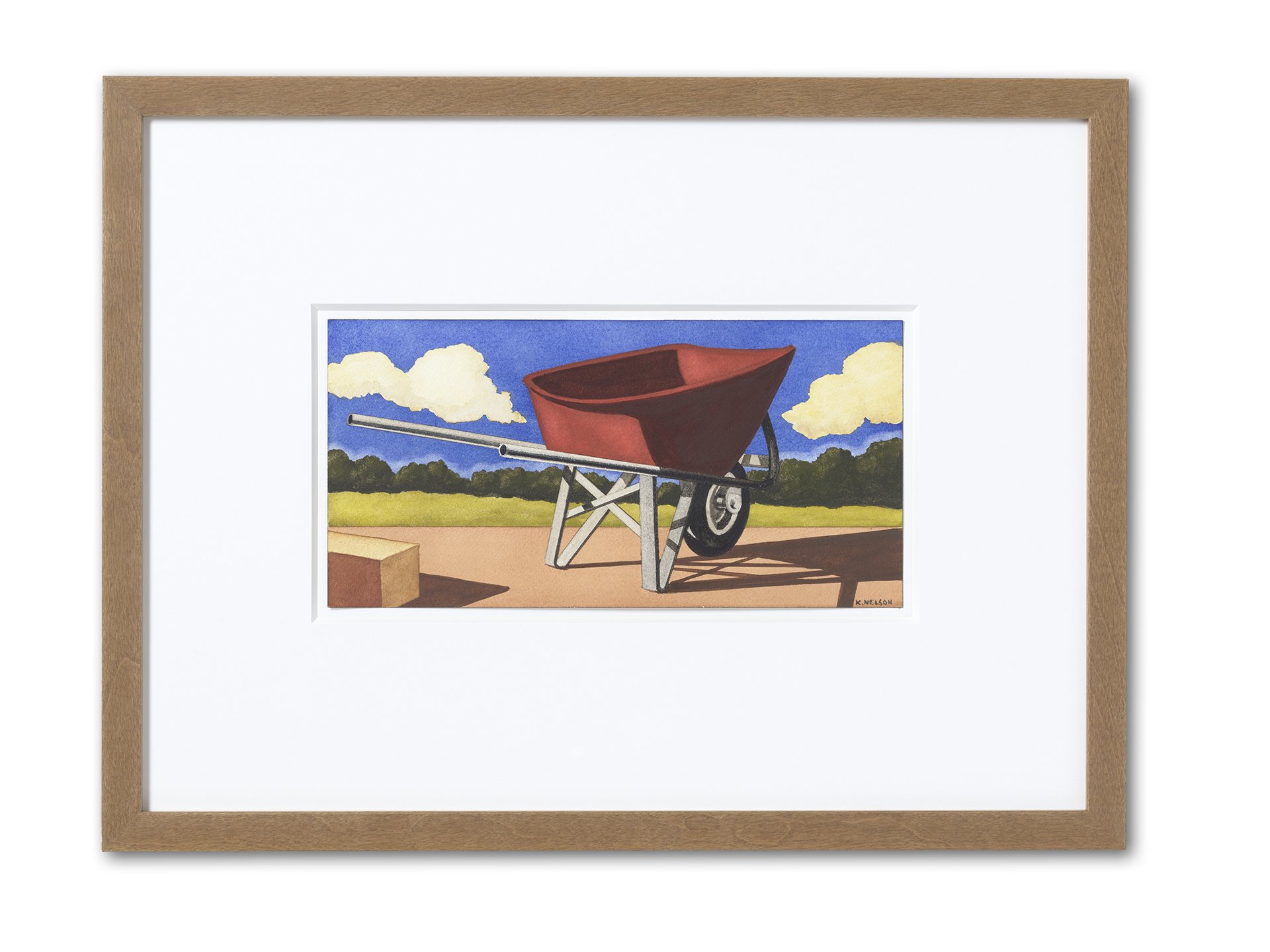
As the exhibition’s title indicates, KENTON NELSON presents ten new watercolors that extend the universe of his stylized imagery and enrich it with new motifs. The pictures render idyllic impressions from his Californian surroundings and captivate the viewer with the delicate, luminous quality that is distinctive to watercolor painting.
“Nelson’s pictures blend spatial distance with emotional depth. His luminous planar visual idiom sets the stage for instants of uncertainty—situations frozen in time in which much remains unresolved.”
Constanze Malissa in Painting a Perfect World, Kerber Verlag 2026
The motifs of the watercolors are drawn from scenes of suburban life imbued with an enchanting reminiscence of the timeless ideal of the past. It is in fact by referencing the advertising aesthetics of the 1950s and adapting it to the contemporary context that the pictures strive to transcend a specific place in time. This principle invites comparison to Thomas Mann’s story The Wardrobe, in which a traveler, cutting the cords that tie him to time, journeys into the unknown without watch or calendar and becomes entangled in a narrative filled with peculiar, enigmatic encounters. Just as Mann’s traveler inhabits the space of that which has no place, the beholder of NELSON’s pictures is presented with a perpetually weightless context that reveals sensitive anecdotes. The latter at most hinted at yet never fully realized, let alone grounded in explicit narrative. The figures should be seen not as individuals but as delicate allegories of inner states of mind and suspended presences.

“We are voyeurs. I would rather leave it up to the viewer’s imagination to finish the story, given my suggestion.”
Kenton Nelson in Painting a Perfect World, Kerber Verlag 2026
In no small part due to their formats, the compositions of the watercolors on view have the aura of close-ups. They cast the viewers as silent accomplices of the moment. As if peering through a keyhole at the artist’s personal feelings, one gazes upon a fragment of life lifted out of context. NELSON’s characteristic compositions clip his motifs and condense them in linear, almost two-dimensional views. Glimpses and vistas as well as a reality that is captured as though in photographs and fragmented in the process coalesce into a larger story that is grasped only in scattered pieces.
KENTON NELSON’s work as an illustrator—most recently, he created a cover for a November 2025 issue of The New Yorker that captures a contemplative moment in the city’s morning light—informs an aesthetic that evokes the visual language of advertisements from the 1930s to the 1950s and incorporates elements of American Scene painting. Along the way, he also references the idealized figurative depictions of ordinary life in America produced by the Federal Art roject under Franklin D. Roosevelt as part of a visual politics that sought to spread a sense of purpose and confidence. This heritage shapes the surface of his paintings, as does a sun-kissed optimism that continually reinforces their enigmatic quality. What remains, upon viewing the works, is the quiet sensation that one may have been to these places before—a peculiar feeling that makes the motifs part of one’s own biography and takes root like distant yet still present memories.